Why Fall Is the Perfect Time to Build Better Soil with Lime
Healthy Turf Starts Below the Surface
 Every fall, homeowners begin thinking about fertilizer, over seeding, and preparing their lawns for winter. While those practices are important, one of the most valuable fall applications often goes unnoticed—lime.
Before turf grass can efficiently utilize nutrients, develop deep roots, or withstand drought and disease, the soil itself must provide the proper growing environment. One of the most important factors influencing soil health is pH.
Rather than viewing lime as a product that’s applied every few years, it should be part of a long-term soil management strategy guided by soil testing. For many New England lawns, that means potentially two lime applications each season to gradually improve soil chemistry while continually supporting healthy turf.
Why New England Lawns Become Acidic
Much of New England naturally has acidic soils. Every year, rainfall, snow melt, plant uptake, prolonged synthetic fertilizer applications, and the natural decomposition of organic matter slowly lower soil pH.
Over time, this gradual acidification changes how the soil functions.
- Grass roots become less efficient.
- Beneficial soil organisms become less active.
- Essential nutrients become more difficult for plants to absorb.
The lawn may receive fertilizer on schedule, yet still struggle to achieve the density, color, and resilience expected from a healthy turf stand.
Soil pH Controls More Than Most People Realize
Soil pH is often described as a measure of soil acidity, but it influences nearly every biological and chemical process occurring beneath the lawn.
As the chart indicates, cool-season turf grass generally perform best when soil pH falls between 6.2 and 6.8.
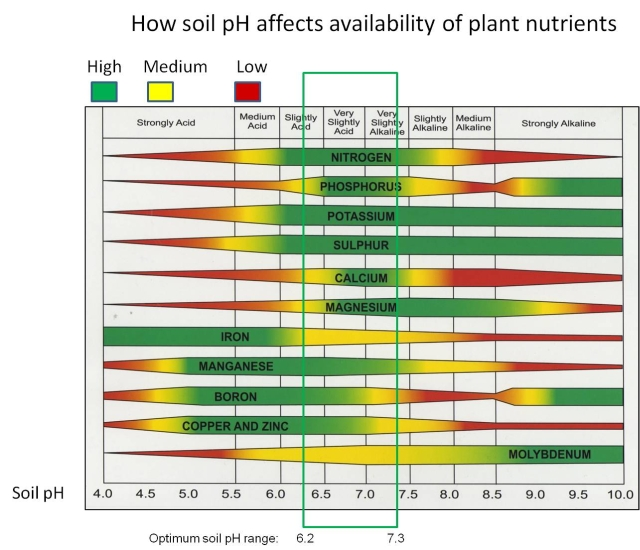
Within this range:
- major nutrients remain readily available
- beneficial bacteria become more active
- earthworm populations thrive
- root development increases
- organic matter breaks down more efficiently
- fertilizer applications become significantly more effective
As soils become increasingly acidic, many of these natural processes begin to slow.
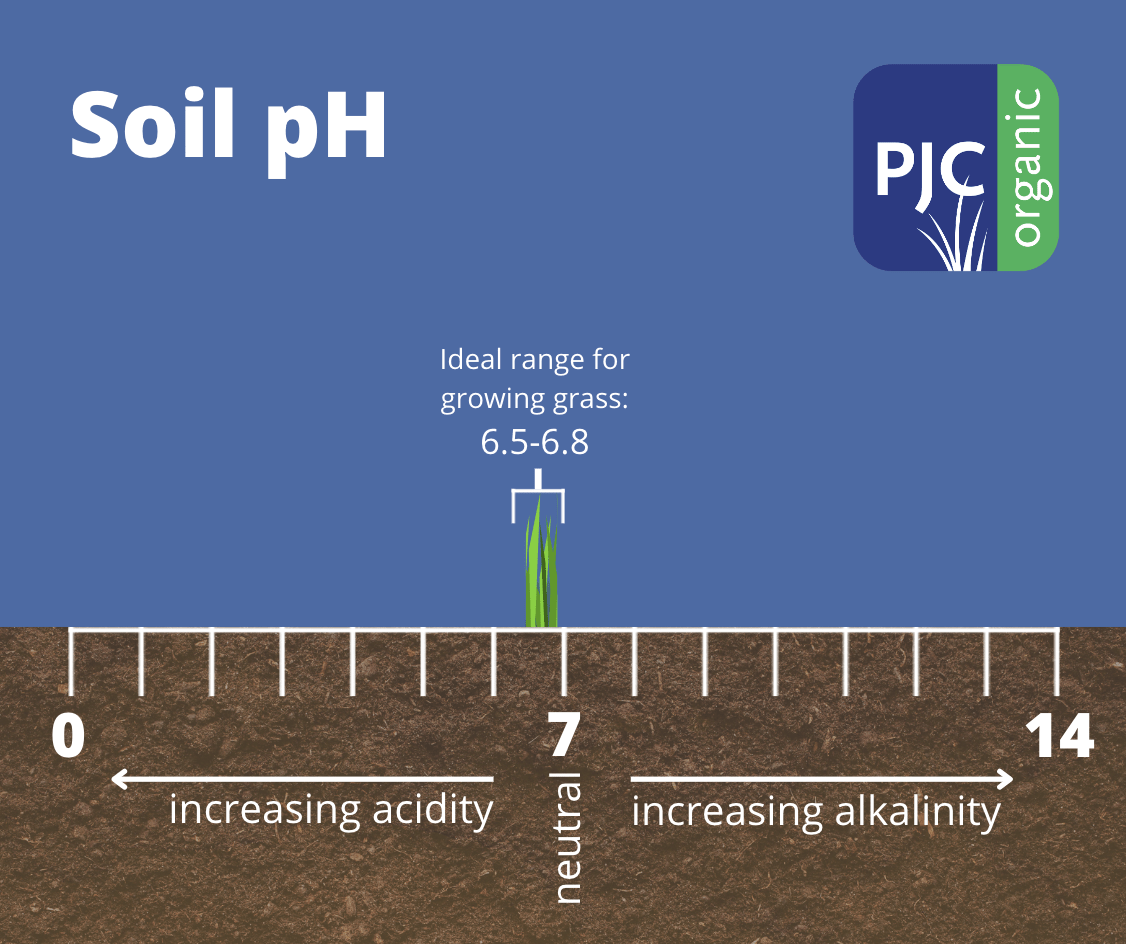
One important fact often overlooked is that the pH scale is logarithmic. A soil with a pH of 5.0 is ten times more acidic than one with a pH of 6.0. A pH of 4.0 is one hundred times more acidic than pH 6.0. Even relatively small changes on a soil test represent substantial differences in the soil environment.
Fertilizer Can’t Solve a Soil Chemistry Problem
One of the most common mistakes homeowners make is assuming thin, pale turf simply needs more fertilizer.
Often, nutrients are already present in the soil but because of acidic conditions turf grass can’t efficiently access those nutrients.
As soil pH declines:
- phosphorus becomes less available
- calcium reserves decrease
- microbial activity slows
- root growth becomes restricted
- fertilizer efficiency declines
Without correcting the underlying soil chemistry, additional fertilizer often provides only limited improvement.
Healthy soil allows every fertilizer application to perform more effectively.
Lime is About More Than Raising pH
Many people think lime only raises soil pH.
While that is certainly one of its primary functions, depending on the type used it also plays a major role in developing healthy soil structure. Healthy soils contain millions of interconnected pore spaces that hold both air and water. Grass roots don’t grow through solid soil particles—they grow through these pore spaces. Choosing a calcitic lime can positively impact this soil structure.
Adequate calcium helps stabilize soil aggregates, creating a stronger soil structure with improved:
- oxygen movement
- water infiltration
- drainage
- root penetration
- resistance to compaction
These improvements become especially valuable following prolonged drought conditions, when many New England soils have become harder, less porous, and more difficult for roots to penetrate.
Healthy Soil Biology Depends on Proper pH
A healthy lawn is supported by an entire ecosystem living beneath the surface.
Beneficial bacteria, fungi, protozoa, nematodes, arthropods, and earthworms continually recycle nutrients, decompose organic matter, and improve soil structure. Many of these organisms perform best when soil pH remains only slightly acidic. As pH declines, biology goes dormant, biological diversity decreases and natural nutrient cycling slows. For organic lawn care, this biological activity is just as important as the nutrients being applied. Building healthy soil means creating an environment where these beneficial organisms can thrive year after year.
Why We Often Recommend Two Lime Applications Per Year
One of the biggest misconceptions about lime is that it should be applied once every several years. At PJC Organic, our recommendations begin with annual soil testing—not the calendar. Many New England soils require gradual improvement rather than one large correction. For that reason, we frequently recommend two lime applications each season based on soil test results and the overall goals of the property.
Multiple lighter applications offer several advantages over one heavy treatment:
- gradual adjustment of soil pH
- improved calcium availability throughout the growing season
- better support for beneficial soil biology
- improved fertilizer efficiency
- lower risk of overcorrecting soil chemistry
- the ability to monitor progress through annual soil testing
Every property is different. Soil texture, cation exchange capacity (CEC), organic matter levels, rainfall, irrigation practices, and previous management all influence how much lime a lawn actually requires.
Why Fall Remains the Most Important Lime Application
Although lime can be applied during much of the growing season, fall remains one of the most valuable opportunities to improve soil chemistry. Unlike fertilizer, lime works gradually. Depending on soil conditions, it may require several months before significant changes occur. Applying lime during the fall allows winter precipitation and natural soil processes to begin incorporating calcium into the soil profile before spring growth begins. For lawns being aerated and overseeded, fall liming also creates an improved environment for developing root systems and establishing new seedlings. This time also ensure by spring, the soil is already moving toward a healthier balance.
Choosing the Right Lime
Not all lime products perform the same.
Traditional agricultural limestone often requires large application rates to produce meaningful changes in soil chemistry.
High-efficiency calcitic lime products use extremely fine particle sizes and enhanced formulations to improve soil contact and reaction efficiency, allowing meaningful improvements with significantly lower application rates. This makes them well suited for professional lawn care programs where consistent annual soil improvement is the objective.
Dolomitic lime, which also contains magnesium, should generally be reserved for soils where testing confirms a magnesium deficiency rather than being used as a universal lime source.
Always Let the Soil Test Make the Decision
Not every lawn needs the same amount of lime.
Two properties may both test at pH 6.0 yet require dramatically different application rates because of differences in buffer pH, organic matter, cation exchange capacity and Ca:Mg ratios.
That’s why every recommendation should begin with a comprehensive soil test evaluating:
- Soil pH
- Buffer pH
- Calcium
- Magnesium
- Organic Matter
- Cation Exchange Capacity (CEC)
- Base Saturation
- Major and Secondary Nutrients
The goal isn’t simply to raise pH—it’s to build a healthier, more balanced soil capable of supporting vigorous turf for years to come.
Healthy Lawns Begin With Healthy Soil
The healthiest lawns are not built in a single season.
They are developed through consistent soil management, annual testing, and gradual improvements in soil chemistry and biology.
Lime is far more than a product that raises pH. It improves nutrient efficiency, supports beneficial microorganisms, strengthens soil structure, promotes deeper rooting, and helps turf become more resilient to drought, disease, traffic, and environmental stress.
At PJC Organic, we view lime as an essential part of a comprehensive soil health program. By using annual soil testing to guide recommendations—and often incorporating two carefully timed applications each season—we help build healthier soils that continue improving year after year.
When the soil improves, everything growing above it improves as well.
Check out our product page or reach out for more info!