PJC’s Practical Organic Turf Care Approach
When it comes to growing turf, there are things outside our control and things that are unrealistic to try to change. PJC’s approach is practical because we focus on the factors within our control that cultivate positive change. We balance sound agronomics, financial sense, and effective practices. The key to a successful all-natural Organic Turf Care (OTC) program is applying the right products alongside proper cultural practices.
PJC’s Healthy Turf Circle 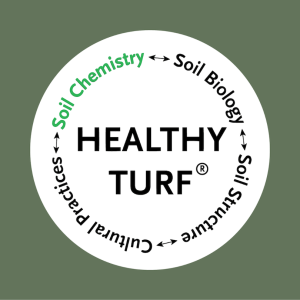
For the month of January, we are diving into PJC Organic’s Healthy Turf Circle — the cornerstone to our practical approach — where we start with the soil. HEALTHY TURF depends on the connection and balance between Soil Chemistry, Soil Biology, Soil Structure, and Cultural Practices.
The 4 Healthy Turf Circle Elements:
- Soil Chemistry: Balancing pH and nutrient levels for optimal plant growth.
- Soil Biology: Encouraging a thriving ecosystem of beneficial microbes.
- Soil Structure: Maintaining aeration, compaction resistance, and good water infiltration.
- Cultural Practices: Employing proper mowing, watering, aeration, and overseeding techniques.
By focusing on these interconnected elements, the program ensures a holistic approach to nurturing turf that is both environmentally responsible and effective.
Soil Chemistry: Why pH Matters Most
The master switch in soil chemistry is soil pH. It acts as the gatekeeper—determining whether nutrients are available, locked up, or excessively soluble. While pH doesn’t directly feed turf, it controls whether nutrients can be absorbed by the plant.
Understanding Soil pH
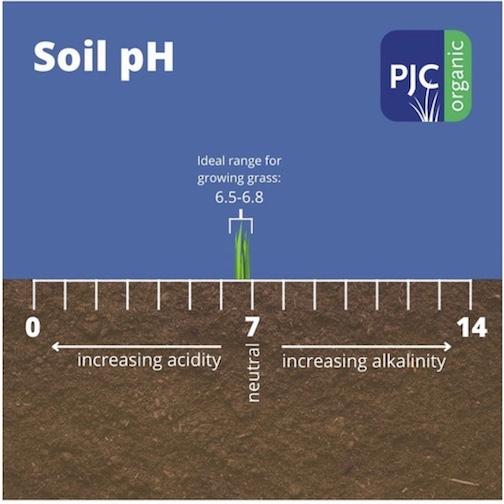
Soil pH (potential hydrogen) measures soil acidity, neutrality, or alkalinity on a scale:
-
- Acidic: pH 6.9 and below
- Neutral: pH 7.0
- Alkaline: pH 7.1 and above
It’s also important to understand how powerful small pH changes can be. Each whole number change in a ph measurement is 10x stronger than the previous. So a ph of 5 is 10 times more acidic than ph 6 and a ph 4 is 100 times more acidic than ph 6.
Ideal Soil pH for Turfgrass
Turfgrass thrives in a pH range of 6.2–6.9, with an ideal target of 6.5–6.8. Within this range, nutrient bioavailability is maximized, supporting stronger, healthier turf. In the Northeast, native soils tend to be acidic—making pH adjustment a critical step in turf success.
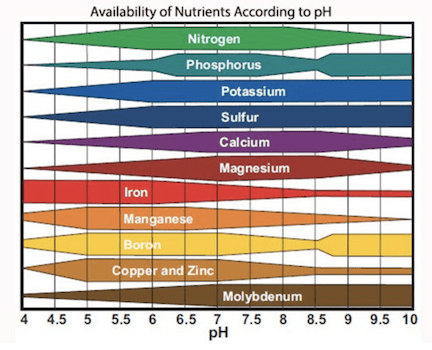
The above graph illustrates nutrient availability across the pH spectrum. It shows that nutrients like nitrogen, phosphorus, and potassium are most accessible at a 6.5 pH. This balance ensures that turfgrass can absorb the nutrients needed for optimal growth and resilience.
Essential Nutrients for Plant Growth
Plants require 16 essential nutrients, divided into macronutrients and micronutrients based on the quantities needed and their role in plant health.
Macronutrients — These nutrients are required in large quantities and play a significant role in plant structure and growth.
- Primary Macronutrients
- Nitrogen (N): Essential for leaf and stem growth.
- Phosphorus (P): Promotes root development and flowering.
- Potassium (K): Supports overall plant health and stress tolerance.
- Secondary Macronutrients
- Sulfur (S): Important for protein formation.
- Calcium (Ca): Strengthens cell walls.
- Magnesium (Mg): Central to chlorophyll production.
- Non-Mineral Macronutrients
- Carbon (C), Hydrogen (H), Oxygen (O): Derived from air and water; vital for photosynthesis and overall plant structure.
Micronutrients — These are required in smaller amounts but are crucial for specific physiological and biochemical processes within the plant.
- Iron (Fe): Important for chlorophyll synthesis.
- Manganese (Mn): Aids enzyme activation.
- Boron (B): Vital for cell wall strength and development.
- Copper (Cu): Essential for enzyme function.
- Zinc (Zn): Influences growth hormone production.
- Chlorine (Cl): Involved in osmosis and ionic balance.
- Molybdenum (Mo): Crucial for nitrogen fixation and utilization.
Soil pH and Nutrient Availability
While these nutrients are often present in the soil, their bioavailability depends heavily on soil pH. Maintaining a pH range of 6.5–6.7 ensures optimal availability of both macro and micronutrients, fostering healthy and robust plant growth.
Proven Products for Correcting Soil Chemistry
When looking at soil chemistry and turf, getting pH in range is the most critical part of an organic turf care program. To do that you need a strategy for adjusting that is data driven. A soil test that includes:r pH, buffer pH, organic matter, cation exchange capacity and Calcium:Magnesium provides your road map that guides product selection.
Why Product Selection Matters
Choosing an all natural organic fertilizer like our PJC Prohealthy Turf Blends makes a difference because you are avoiding an ammonium based nitrogen fertilzer that lowers ph . PJC also offers a High Efficiency Calcitic Lime with 2% Humic Chelating Agent that works faster and more efficiently than standard lime to change the soil chemistry. The calcium carbonate alkalizes soil pH (Increases), while the humic chelating agent even furthers the availability of nutrients in the soil. We also offer gypsum to further adjust the Calcium and Magnesium ratios in soil.
Impact of pH Correction
Once the soil’s pH is within the target range (6.5–6.8)…
- Nutrients become abundantly available to turfgrass.
- The desired soil biology can thrive, creating a balanced and sustainable ecosystem.
Have questions about soil chemistry or turf care? Looking for product information or pricing? Contact us, we’re here to help!
Tune in next week for PJC’s Healthy Turf Circle & Soil Biology.