Soil Biology and Turf Care: Building Healthy Grass from the Ground Up
If you haven’t yet, check out last week’s blog, “Soil Chemistry and Turf”, for a deep dive into the first element of our Healthy Turf Circle: soil chemistry and its role in turf health.
This week, we’re focusing on Soil Biology and its critical role in organic turf care.
The Role of Soil Biology

Quality Organic Turf Care Programs rely on living organisms in the soil to feed the grass plant, rather than pushing growth through soluble inputs.
Healthy soil biology is essential because soil microorganisms:
- Break down organic matter
- Convert nutrients into bio-available forms plants can readily absorb
- Help build soil structure
- Protect turf naturally from unwanted pests
When soil biology is healthy, turf growth is stronger, more resilient, and more sustainable.
The Soil Food Web: Supporting Life Beneath the Turf
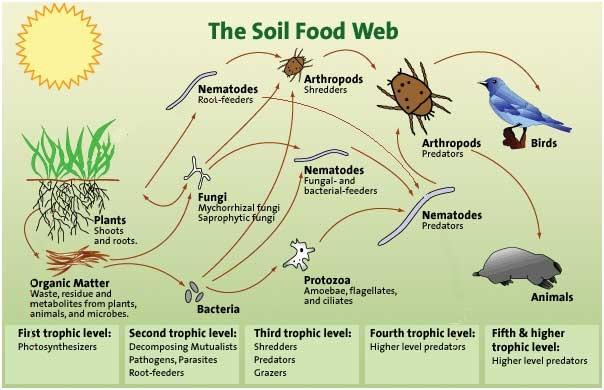
The Soil Food Web illustrates the complex interactions and life cycles of organisms within the soil ecosystem. For turf grass, managing this web is essential to creating a thriving and sustainable system.
When the Soil Food Web is functioning properly, it stores and releases nutrients efficiently, providing consistent and even turf growth throughout the season.
In an organic program, we are primarily focused on influencing activity in the first and second trophic levels through cultural practices and targeted product inputs.
Encouraging Beneficial Bacteria
In turfgrass management, bacterially dominated soils with balanced fungal populations are ideal. Encouraging beneficial bacteria plays a critical role in nutrient cycling.
Key Beneficial Bacteria in Turf Soils
- Nitrifying and Denitrifying Bacteria (e.g., Nitrobacter)
Convert nitrogen into plant-available forms - Nitrogen-Fixing Bacteria (e.g., Azotobacter)
Capture atmospheric nitrogen and make it bio-available to plants
These bacteria form a symbiotic relationship with turfgrass, supporting consistent, sustainable growth.
In contrast, acidic soils tend to be more fungal-dominant and are typical of ecosystems like old-growth forests, which are common in the Northeast. These soils are less conducive to turfgrass growth and often require adjustments to achieve a more favorable bacterial balance.
Feeding Soil Biology with PJC Organic Products
PJC ProHealthy Turf® granular fertilizers and soil amendments are designed to feed soil biology, allowing the biology to feed the grass plant in return.
Our products are formulated to keep the microbial community active and thriving throughout the growing season by providing a diverse range of food sources and feed cycles. This approach supports:
-
Nourishment for Microbes
A steady food source for beneficial soil organisms -
Reproduction and Growth
Increased microbial populations and enhanced biological activity -
Biological Balance
Long-term alignment of soil biology to support healthy, sustainable turfgrass
By nurturing soil biology with all-natural organic inputs, you create a system where turf thrives naturally without synthetic inputs, and remains safe for people, pets, and the environment.
A Slow and Steady Approach to Building Soil Biology
A successful Organic Turf Care Program requires patience and consistency. Taking a slow, steady approach allows microbial populations to establish, multiply, and flourish over time.
The result is long-term turf health, improved soil performance year after year, and reduced input requirements—all while working in harmony with nature.
Want to implement sustainable turf care? Got questions about soil biology? Need more product info and pricing? Contact us!