
Cultural Practices That Encourage Spring Turf Growth
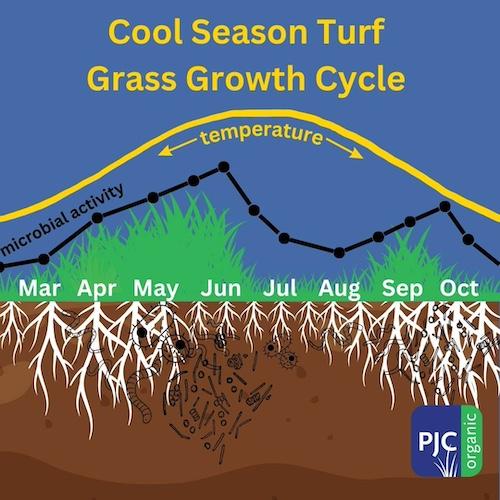
As we’re on the cusp of spring work beginning, it’s important to remember how temperature determines when and where your grass grows. Understanding how temperature influences grass behavior, especially during early spring, helps you nurture a healthier, more resilient lawn.
Follow these guidelines and cultural practices that encourage turf growth in spring.
Temperature & Cool-Season Grasses
As weather cools in late fall, grass enters a dormant phase to conserve energy and protect itself from freezing temperatures. During this time, metabolic processes slow down and growth halts. The grass typically turns brown or straw-like as it conserves resources, preparing for the cold months ahead.
In spring, cool-season grasses do not begin growing until soil temperatures consistently rise above 50°F. Over the last few years, there has been increased variability in when we reach this point.
As we begin to exit dormancy, it’s essential to understand how to care for your grass so it can recover and thrive during early spring.
Early Spring Temperatures and Root Growth
During early spring, when temperatures are cooler, grass plants focus a significant amount of energy on root development. Root growth is typically more active at lower soil temperatures and continues through the cooler months.
New crown development usually begins when soil temperatures reach approximately 50°F to 55°F (10°C to 13°C). As crowns develop, they produce new shoots and roots.
At this stage, turfgrass is fragile and in the process of anchoring itself into the soil. Mechanical, surface-level activity can damage the new crowns, leading to stress or even dieback.
Dethatching Damage in Early Spring
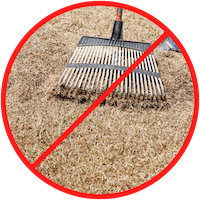 Customers often think their lawn has dead grass that needs to be removed, when in fact it is dormant grass.
Dethatching or heavy raking can damage grass by pulling up or cutting into the crown as it comes out of dormancy. This removes valuable organic material and can leave the lawn thin and susceptible to weed pressure.
Disruptive spring cleanups of lawn areas should be avoided, particularly in early spring. In an organically managed lawn, dethatching is rarely needed because soil biology naturally breaks down the thatch layer.
Instead:
- Use leaf blowers to remove leaves and debris.
- Only dethatch when the thatch layer has reached a thickness that could harm the lawn.
- Always assess the side profile of the soil — not just the surface appearance — before making a decision.
Potential harm cannot be determined from a visual inspection of the surface alone.
Field and Lawn Compaction in Spring
In early spring, soils are typically wet from snowmelt and spring rains, making them especially vulnerable to compaction. During this period, newly emerging grass crowns are highly sensitive to pressure.
Foot traffic and heavy equipment can easily compress wet soils, reducing oxygen in the root zone and restricting root development. Compaction limits water and nutrient movement, leading to:
- Weak growth
- Thinning turf
- Patchy lawn conditions
To protect your grass:
- Minimize traffic until soils have dried and stabilized.
- Use lighter equipment whenever possible.
- Avoid unnecessary surface disruption.
Should You Aerate in the Spring?
Aerating a lawn or athletic field too early in spring can damage the crowns of newly sprouted grass.
Mechanical aerators — especially those with heavy tines or spikes — can pull up or disrupt shallow roots and crowns, impeding their ability to establish a healthy root system. Spring aeration can also increase weed seed germination due to surface disruption.
Given these risks, spring aeration should only be used on areas prone to heavy compaction, such as athletic fields. Most residential properties only require one aeration per season to manage compaction, and that should be performed in the fall when grass is actively growing.
Early Spring Mowing Practices
The first few mows of the season have a significant impact on future turf success and should be approached carefully.
Mowing too early — or cutting too much of the grass blade in a single pass — can damage delicate crowns, leading to stress or dieback. Before the grass has had a chance to fully establish, mowing can tear tender grass blades and stunt future growth.
Follow these best mowing practices:
- Use sharp mower blades.
- Remove no more than one-third of the grass blade height.
- Wait until grass reaches 3–4 inches before the first cut.
- Set the first cut at approximately 2.5 inches.
- Start the season lower and gradually raise the height as the season progresses.
Remember, grass feeds itself through photosynthesis, which occurs in the grass blades. Protecting leaf tissue protects plant health.
Setting Your Lawn Up for a Healthy Growing Season
Early spring months are crucial for cool-season grass development. By understanding growth stages and avoiding activities that harm delicate new growth, you help your lawn recover from dormancy and set the stage for a healthy, thriving turf throughout the growing season.
- Be gentle with your grass.
- Minimize disturbances.
- Allow time for strong roots and healthy crowns to establish.
Support Strong Spring Turf Growth with PJC Organic
Healthy spring turf growth starts with understanding soil temperature, root development, and proper cultural practices. Although, long-term success also depends on building soil health.
At PJC Organic, we specialize in organic turf management solutions that strengthen root systems, improve soil biology, and support resilient cool-season grass throughout the growing season. Whether you manage athletic fields, municipal properties, schools, or residential landscapes, our programs are designed to work with nature, not against it.
If you’re preparing your fields or lawns for spring, connect with the PJC Organic team to build a program that supports healthy crowns, deeper roots, and sustainable turf performance all season long.
Learn more about our organic turf programs at PJCOrganic.com.